
The Supreme Court reinforces the bank's duty to provide information in subrogations.

The Supreme Court reinforces the bank's duty to provide information in subrogations.

El Tribunal Supremo ha dictado recientemente la Sentencia núm. 161/2026, de 4 de febrero, que afecta a miles de compradores de vivienda (incluso locales) que, al adquirir el inmueble a un promotor, se subrogaron en el préstamo hipotecario ya existente.

La Sala Primera recuerda que el banco debe garantizar que el comprador tenga conocimiento real de las condiciones esenciales del préstamo (especialmente, cómo se calcula el interés). Si no se cumple ese deber, la cláusula de interés puede considerarse no incorporada y el préstamo puede quedar sin interés remuneratorio, con derecho a la devolución de los intereses ya pagados más los intereses legales que correspondan.

En el caso resuelto, los compradores se subrogaron en un préstamo del promotor que les vendió la vivienda, pero en la escritura de compraventa no constaba el tipo de interés ni cómo se determinaba y no se acreditó que se les hubiera entregado copia de la escritura del préstamo del promotor con las condiciones completas.

Por ello, el Tribunal Supremo concluye que, en estas operaciones, la entidad bancaria no puede desentenderse, aunque el préstamo se suscribiera con el promotor. Cuando el comprador se subroga con el consentimiento del banco, existe obligación de información suficiente para que el consumidor comprenda la carga económica y jurídica de lo que asume.

En consecuencia, la Sentencia declara no incorporada la cláusula que fijaba el interés remuneratorio y condena a devolver todas las cantidades cobradas por este concepto, junto a los intereses legales desde cada cobro, y a mantener el contrato vigente con el resto de condiciones, pero sin aplicar el interés remuneratorio.

Esta postura jurisprudencial puede beneficiar especialmente a quienes compraron una vivienda (o local) a un promotor (o a un vendedor) y se subrogaron en la hipoteca ya existente.

Si te encuentras en esta situación, desde Montelirio Abogados y Asesores Tributarios analizamos tu caso y te indicamos si resulta viable iniciar el procedimiento contra la entidad bancaria para recuperar todos los intereses remuneratorios abonados y seguir pagando las cuotas del préstamo sin intereses.
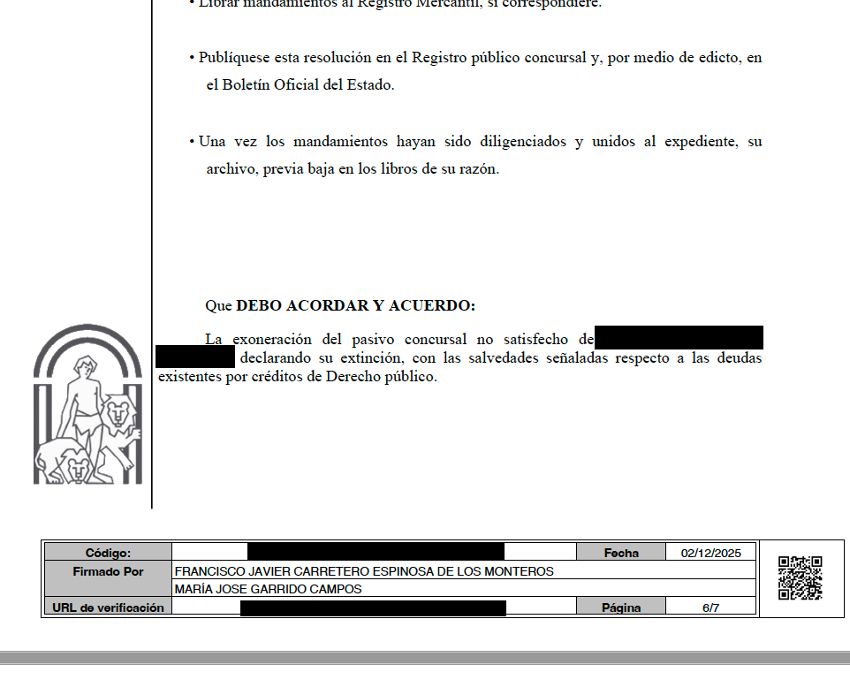
We wrote off more than €31,000 in debt for a client thanks to the Second Chance Law.

We wrote off more than €31,000 in debt for a client thanks to the Second Chance Law.

At Montelirio Lawyers and Tax Advisors, we continue to demonstrate that the Second Chance Law works when applied with the right strategy and legal rigor.

Recently, our firm has managed to get a client released from more than €31,000 in debt, achieving exoneration of unsatisfied liabilities.

Our client was in a situation of unsustainable over-indebtedness and did not have sufficient assets to meet his obligations. After analyzing his case, we initiated bankruptcy proceedings and requested the discharge of his debts.

The Commercial Court No. 4 of Seville has issued a ruling granting the exoneration of all exonerable debts, definitively ending his insolvency and allowing him to start afresh.

From now on, creditors cannot claim any amount from you for the debts that have been discharged, and you will regain your personal and financial peace of mind.

Each case is different, but proper legal planning makes all the difference. At Montelirio Abogados y Asesores Tributarios, we have a department specializing in commercial law that is prepared to analyze each situation individually and determine whether it is possible to take advantage of the Second Chance Law mechanism.

If you find yourself overwhelmed by debt that is preventing you from moving forward, we encourage you to contact us so we can review your case, assess the feasibility of this type of procedure, and help you start afresh.

Personal income tax exemption on the salary of Spanish military personnel on international missions.

Personal income tax exemption on the salary of Spanish military personnel on international missions.

The Supreme Court has confirmed in its rulings of April 8, 10, and 21, 2025, that the remuneration received by Spanish military personnel assigned to international missions—specifically, UN operations abroad and aboard ships in international waters under NATO command—is exempt from personal income tax, in accordance with the provisions of Article 7.p) of the Personal Income Tax Law.

This Supreme Court ruling represents an important recognition of the right of Spanish military personnel not to pay income tax on earnings obtained for work carried out abroad during these missions.

Consequently, Spanish military personnel who have been deployed on this type of international mission, in addition to no longer having to include in their income tax returns income derived from work related to their position or function carried out abroad, THEY MAY REQUEST THE CORRECTION OF THEIR INCOME TAX SELF-ASSESSMENTS FOR YEARS NOT SUBJECT TO THE STATUTE OF LIMITATIONS AND CLAIM A REFUND OF UNDUE PAYMENTS.

Our firm offers specialized advice on tax law and handles the entire process: analysis of the specific situation, compilation of documentation, preparation of the request for rectification, and follow-up with the Tax Agency.

If you have been assigned to this type of international mission in recent years, you are very likely entitled to a refund of part of the income tax you have paid. Contact us for a no-obligation assessment of your case. The time frame for claiming a refund is limited.

The CJEU opens the door to new claims for loans referenced to IRPH

The CJEU opens the door to new claims for loans referenced to IRPH

On December 12, 2024, the Court of Justice of the European Union (CJEU) issued a key ruling in case C-300/23, resolving the preliminary question raised by the Court of First Instance No. 8 of San Sebastian. This decision introduces nuances that may radically change the outlook for those affected by the Mortgage Loan Reference Index (IRPH) in their mortgage contracts.

Increased transparency control requirements

The CJEU reiterates what was stated in its July 2023 Judgment, establishing that it is up to the national judge to analyze whether the contract complies with the transparency control. This implies verifying whether the consumer received all the necessary information on the IRPH, including its calculation method and the economic consequences derived from its application.

In addition, the Ruling introduces a novel element: the information to the borrower may come from publicly accessible sources, but the lender must provide clear and precise indications so that the average consumer can understand them without the need to carry out complex legal research. In this sense, informing of the publication of the IRPH in the BOE could be sufficient to overcome the transparency control; not doing so, on the other hand, could imply a breach.

The key: negative spread

One of the most important points of the Judgment is the reference to the application of a negative spread to the IRPH. According to the CJEU, due to its calculation method, the IRPH should be adjusted to the market APR by applying a negative spread. If this adjustment was not made and the consumer was not duly informed, it could be considered an abusive clause and, therefore, null and void.

This interpretation puts in check the criterion of our Supreme Court, which had validated the IRPH arguing that it was an official index used by the public administrations in the financing of subsidized housing. The CJEU undermines this argument by stating that the good faith of the lender cannot be presumed solely on the grounds that the IRPH is a government-regulated index.

Nullity and effects in mortgage contracts

Another fundamental aspect addressed in the Judgment is the impact of a possible declaration of nullity of the IRPH. The CJEU establishes that, if the elimination of the clause makes the contract unfeasible, the judge could replace it with a supplementary provision of national law. However, as of today, there is no such provision in Spain, which generates a situation of legal uncertainty that will have to be resolved by the Supreme Court or the legislator.

How does this ruling affect consumers?

This CJEU decision strengthens the position of consumers affected by the IRPH, opening the possibility of claiming the nullity of the clause in certain cases. In particular:

  • If they were not correctly informed about the IRPH calculation method.
  • If the bank did not explain the need for a negative spread to bring the APR in line with the market.
  • If the information provided was not sufficiently clear and accessible.

At Montelirio Abogados y Asesores Tributarios, we have a Commercial and Banking Law department that is prepared to analyze each case individually and evaluate the claim options. If you have a loan referenced to IRPH, we encourage you to contact us to review your situation and assess the possibility of recovering what you are entitled to.

Call Now Button
Privacy Policy

This website uses cookies so that we can provide you with the best possible user experience. Cookie information is stored in your browser and performs functions such as recognizing you when you return to our site or helping our team understand which sections of the site you find most interesting and useful.

More info about privacy policy: Privacy Policy